
Maximizing Whole Life Strategies for Cash Value

Maximizing Whole Life Strategies for Cash Value
Whole life insurance cash value strategies center on tax-deferred growth that policyholders borrow against for business funding, supplemental retirement income, or liquidity events, without triggering immediate taxation. High-income earners and business owners pair A+ rated carrier policies with living benefits riders, creating a private capital source alongside a tax-free death benefit for beneficiaries.
Key Takeaways
- Whole life insurance provides lifetime coverage as long as policyholders maintain premium payments consistently.
- Cash value components accumulate tax-free within whole life policies, offering additional financial flexibility.
- Policyholders access cash value through loans or withdrawals without triggering income tax consequences.
- Whole life insurance guarantees death benefits reach beneficiaries tax-free, protecting families financially.
What Do You Need Before Building a Strategy?
Four prerequisites determine whether a cash value plan succeeds: licensed guidance, timing, personal financial mapping, and patience. Skipping any one of these creates gaps that surface years later, often when a client least expects them.
Licensed advisors who favor calm, no-pressure guidance set the foundation. Sound whole life strategies emerge from conversation, not a sales pitch, and clients deserve advisors who explain tradeoffs clearly before any paperwork begins.
Why does timing matter so much?
Premiums lock in at the age of purchase and stay level for life. Buying earlier secures a lower rate that never increases, making age itself a financial variable worth acting on sooner rather than later.
Clients should also confirm these before moving forward:
- Current obligations: children, a mortgage, a business, retirement goals
- A clear purpose for the use of cash value down the road
- Realistic patience, since cash value grows steadily and accrues interest over years, not months
Coverage built around real circumstances, not a generic template, makes whole life policy planning durable.
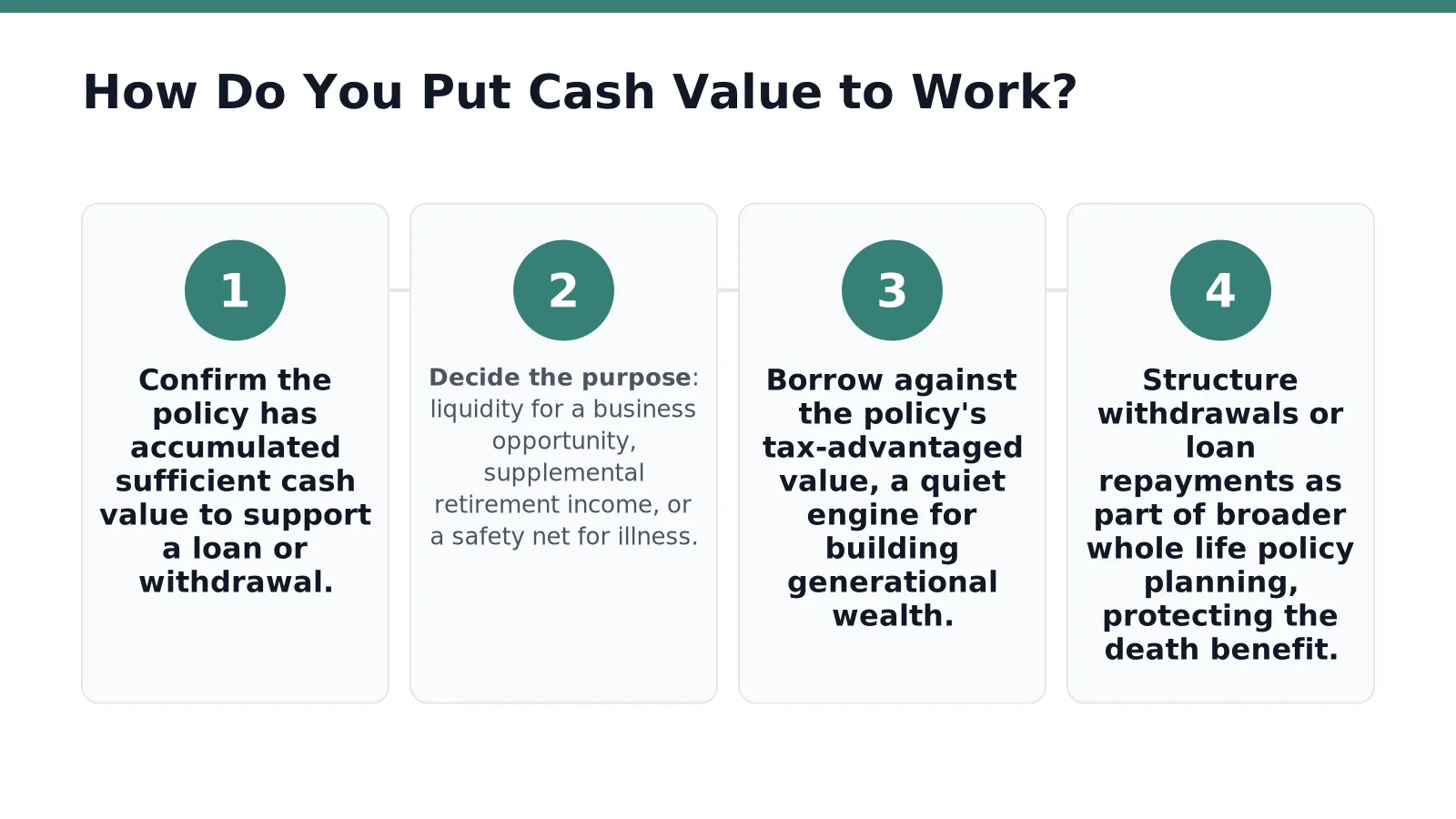
How Do You Put Cash Value to Work?
Policyholders put accumulated cash value to work through three main paths: borrowing against it, drawing on living benefits during illness, or converting it into retirement income. Each premium payment directs a portion of that money into the policy’s overall cash value balance, building the foundation clients later tap. Skipping this planning stage leaves significant wealth sitting idle inside a policy instead of working for the family.
Executing whole life strategies effectively follows a logical sequence:
- Confirm the policy has accumulated sufficient cash value to support a loan or withdrawal.
- Decide the purpose: liquidity for a business opportunity, supplemental retirement income, or a safety net for illness.
- Borrow against the policy’s tax-advantaged value, a quiet engine for building generational wealth.
- Structure withdrawals or loan repayments as part of broader whole life policy planning, protecting the death benefit.
What counts as proper use of cash value during illness?
Living benefits riders allow policyholders to access a portion of the death benefit while still living, specifically for critical, chronic, or terminal illness. This feature turns a policy into active financial protection, not just a future payout.
Can cash value fund retirement income?
Retirement strategies built on cash value generate predictable income streams designed to compound across decades, outlasting the policyholder.

What Mistakes Should You Avoid With Cash Value?
Four missteps undermine most whole life strategies before they build real value. Each one is avoidable with the right planning sequence.
- Choosing an insurer on price alone. A policy’s long-term promise only holds if the carrier remains financially stable decades from now.
- Squeezing premiums into too few years. Shorter payment windows raise the total cost, since the same coverage gets funded over a compressed timeline.
- Treating the policy as “set and forget.” High-income earners and business owners face shifting tax exposure and liquidity needs, and strategy should move with them.
- Skipping a professional line-by-line review. Structuring errors in use of cash value often go unnoticed until they’ve already cost money.
How often should a whole life policy be reviewed?
Ongoing advisor access matters more than a single setup conversation. Advisors who stay engaged through career changes, acquisitions, or retirement transitions help clients recalibrate whole life policy planning before small misalignments compound into real losses.
FAQ
Why does buying whole life insurance early matter?
Buying earlier secures a lower rate that never increases, making age a financial variable worth acting on sooner.
How do policyholders access their cash value?
Policyholders borrow against the cash value, draw on living benefits during illness, or convert it into retirement income. Each approach taps tax-advantaged funds without triggering immediate taxation.
What role do living benefits riders play in a policy?
Living benefits riders let policyholders access a portion of the death benefit while still living, specifically for critical, chronic, or terminal illness. This turns the policy into active financial protection, not just a future payout.
Conclusion
In closing, whole life insurance cash value strategies offer a meaningful way to build financial security while protecting your family’s future. By understanding how cash accumulation works and exploring withdrawal and loan options, you position yourself to make informed decisions aligned with your long-term goals. The right strategy depends on your unique circumstances, timeline, and financial priorities, making personalized guidance essential as you navigate this important decision.