
Life Insurance Calculator: How Much Life Insurance Do You Need?

Life Insurance Calculator: How Much Life Insurance Do You Need?
A life insurance needs calculator estimates coverage by tallying debts, income replacement, and future expenses like college funding. Proper Life Insurance offers free consultations with A+ rated carriers, protecting over 1,000 families. Most households remain underinsured, 41% lack adequate coverage. A personalized review determines the exact amount needed without overpaying.
Key Takeaways
- A life insurance needs calculator tallies debts, income replacement, and future expenses like college funding.
- Most households remain underinsured, with 41% lacking adequate coverage.
- The 10-times-income rule ignores existing savings, debts, and other life insurance policies in force.
- The DIME formula totals Debt, Income, Mortgage, and Education to structure coverage needs.
What Is a Life Insurance Calculator?
A life insurance calculator is a financial planning tool. It estimates the coverage amount a family needs after a breadwinner’s death. The tool analyzes specific financial obligations, income replacement needs, and future goals. Without this calculation, families risk carrying far less protection than their circumstances demand.
The calculator examines factors unique to each household. Securian’s Life Insurance Needs Calculator notes that the right coverage amount depends on a family’s financial situation and life stage. A coverage calculator moves beyond guesswork. It replaces vague rules of thumb with a structured assessment of debts, income, and long-term objectives.
How Does the Calculator Determine Coverage Needs?
The tool processes several financial inputs to produce a recommended death benefit. It accounts for immediate expenses and ongoing obligations.
- Enter current annual income and the number of years dependents will need support.
- List all outstanding debts, including mortgage balances, car loans, and credit card obligations.
- Add future funding goals, such as college tuition for each child.
- Include final expenses like funeral costs and outstanding medical bills.
Life insurance addresses more than burial costs. Securian emphasizes that a policy creates a lasting impact by paying off a mortgage or funding a college education. The calculator translates these goals into a concrete dollar figure.
Why Use a Calculator Instead of a Simple Formula?
Generic formulas often miss critical financial details. A common guideline suggests multiplying income by 10. That approach ignores a family’s debt load, savings, or specific legacy goals. A detailed how much life insurance do I need analysis prevents underinsurance. Proper Life Insurance, based in Norman, Oklahoma, provides objective, no-pressure policy reviews led by licensed experts. These reviews help clients understand precisely what their calculation means. A precise estimate ensures dependents maintain their standard of living without financial disruption.

How Much Life Insurance Do I Need?
Determining the right coverage amount starts with a clear-eyed look at a family’s financial obligations. A life insurance calculator or coverage calculator provides a structured estimate, but understanding the underlying formulas helps clients evaluate the results. The question of how much life insurance do I need has no single answer. It depends entirely on income, debts, and future goals.
What Is the Income Multiplication Method?
The simplest approach multiplies a breadwinner’s gross annual income by 10 to 15. Life Happens identifies this as a quick way to generate a rough coverage target. A household earning a typical annual salary, for instance, would consider a policy in a similar range. This method offers speed. It lacks precision.
The “10 times income” guideline fails to examine a family’s specific financial landscape. NerdWallet notes that this rule does not account for existing savings, current debts, or other life insurance policies already in force. A family with substantial assets and no mortgage needs far less coverage than the formula suggests. Relying solely on a multiple of income risks a significant coverage gap.
How Do Dependents Change the Calculation?
Families with children must look beyond simple income replacement. Another widely cited formula adds $100,000 per child specifically for college education expenses, according to Life Happens. A household with two children would therefore add a significant amount to the base coverage amount. This adjustment acknowledges a major future cost that income replacement alone might overlook.
The income multiplication method also leaves a critical group unprotected. NerdWallet points out that the formula provides no coverage amount for stay-at-home parents. These individuals perform essential labor, including childcare and household management, that would cost tens of thousands of dollars to replace annually. A family signs your family is underinsured when it ignores the economic value of a non-working spouse. Proper Life Insurance reviews these overlooked liabilities during a comprehensive policy assessment.
Why Buy More Coverage Than the Estimate?
Experts consistently recommend erring on the side of caution. Life Happens advises purchasing slightly more life insurance than the initial calculation suggests. Inflation erodes the value of a fixed death benefit over time. A policy purchased today will not carry the same purchasing power in 20 years. A modest buffer protects against this silent erosion and covers unexpected final expenses. The goal is not a perfect number. The goal is a durable safety net that performs when a family needs it most.
How Do I Use the DIME Formula?
The DIME formula calculates life insurance needs by totaling four specific financial obligations. A coverage calculator built on this method replaces guesswork with a structured, dollar-by-dollar assessment of what a family would lose.
The acronym stands for Debt, Income, Mortgage, and Education. Each category represents a distinct financial gap that opens when a breadwinner’s earnings stop. Without a precise total, families carry the silent risk of underinsurance. Life Happens notes that a ballpark figure emerges by adding up immediate, ongoing, and future expenses a household would incur. A life insurance calculator grounded in DIME ensures no major obligation gets overlooked.
What Does Each Letter in DIME Cover?
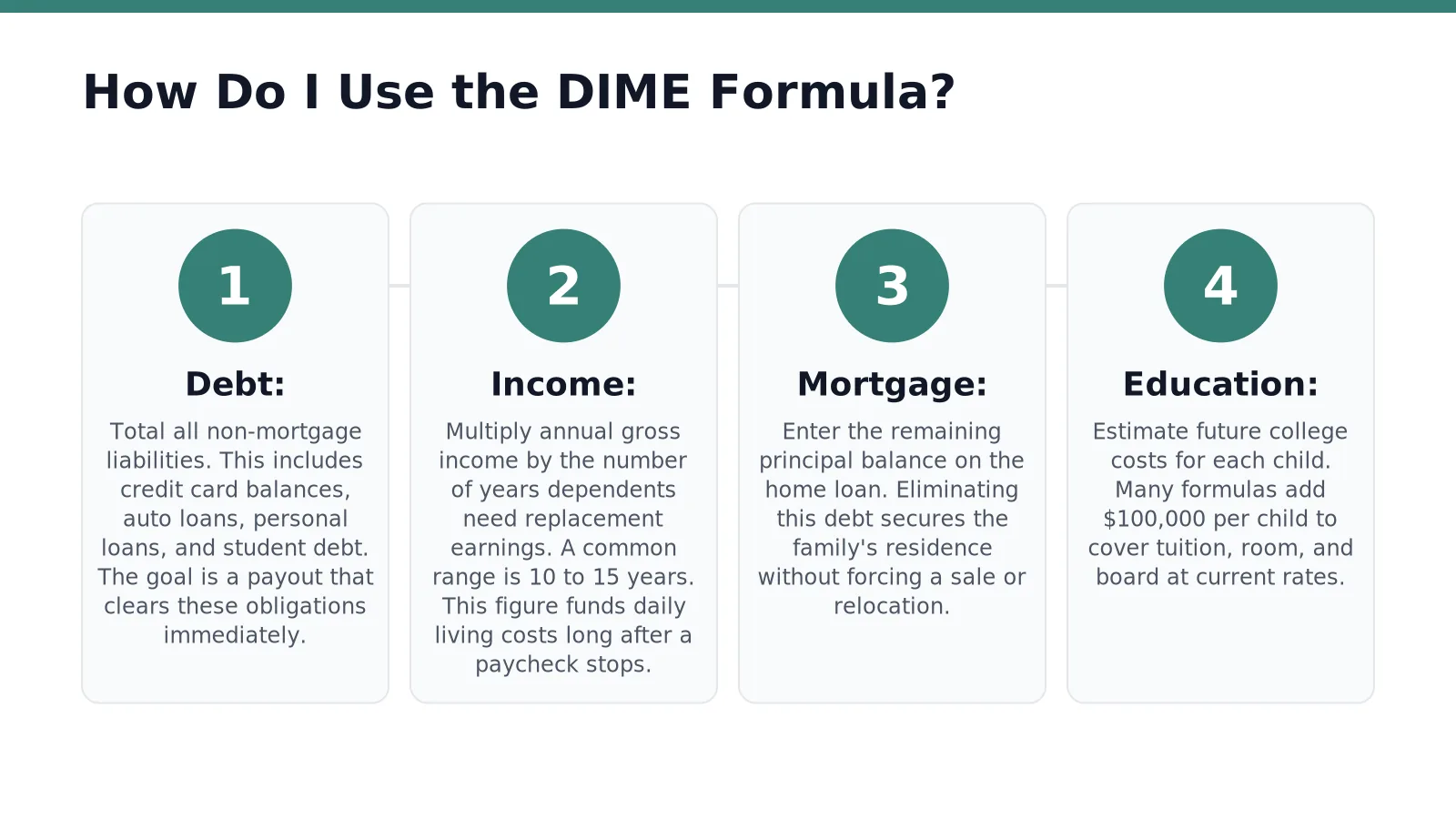
- Debt: Total all non-mortgage liabilities. This includes credit card balances, auto loans, personal loans, and student debt. The goal is a payout that clears these obligations immediately.
- Income: Multiply annual gross income by the number of years dependents need replacement earnings. A common range is 10 to 15 years. This figure funds daily living costs long after a paycheck stops.
- Mortgage: Enter the remaining principal balance on the home loan. Eliminating this debt secures the family’s residence without forcing a sale or relocation.
- Education: Estimate future college costs for each child. Many formulas add $100,000 per child to cover tuition, room, and board at current rates.
How Does a Calculator Refine the DIME Estimate?
A coverage calculator refines raw DIME inputs by factoring in marital status, age, and life stage. Securian’s needs calculator uses these variables to estimate how much insurance helps a family meet financial goals without the breadwinner’s income. The tool adjusts income-replacement years and education funding timelines based on the youngest child’s age.
Proper Life Insurance applies this framework through a line-by-line analysis with clear explanations and personalized recommendations. Clients book a 30-minute video consultation and receive a prioritized action plan. The output is not a generic multiple of income. It is a coverage target tied to real debts, real timelines, and real family priorities.
What Should a Coverage Calculator Include?
A coverage calculator must account for the financial obligations a family carries after a breadwinner dies. Life insurance proceeds help pay off a mortgage, provide college funding, or ease the burden of daily living expenses. A calculator that ignores these obligations produces a coverage number that fails under real-world pressure.
How much life insurance do I need depends on obligations that change over time. A life insurance calculator should follow a structured sequence:
- List all debts. Include the remaining mortgage balance, auto loans, and credit card balances.
- Estimate income replacement. Multiply annual gross income by the number of years dependents need support.
- Add education costs. Account for each child’s college funding needs.
- Subtract existing assets. Deduct savings, investments, and any current life insurance coverage.
What Obligations Does a Calculator Miss?
A calculator that stops at debts and income overlooks final expenses and medical costs. Life insurance also makes a longer, more lasting impact on a family’s future. Proper Life Insurance pairs coverage to a client’s real life, including kids, mortgage, business, and retirement, never a generic template.
Why Does Carrier Strength Matter in the Calculation?
The coverage amount means nothing if the insurer cannot pay the claim decades later. Proper Life Insurance works only with the most financially stable insurers, so the promise lasts as long as the policy. Whole life plans build tax-advantaged value a client can borrow against, a quiet engine for generational wealth. Clients seeking plain-language answers to common coverage questions can review the life insurance FAQs for additional guidance.
Why Get a Professional Policy Review?
A professional policy review uncovers coverage gaps that leave families exposed. Proper Life Insurance translates the fine print into clear language, then stays with clients for the long arc.
What happens during a policy review?
The process follows a straightforward sequence designed for clarity, not pressure.
- Gather every existing policy document and beneficiary designation.
- Schedule a no-obligation consultation with a licensed advisor.
- Walk through current coverage line by line, identifying overlaps and shortfalls.
- Receive a plain-language summary of findings and options.
Proper Life Insurance was founded on the idea that life insurance is one of the most important financial decisions a family will ever make. A review ensures that decision still fits.
Is a review still valuable if the policy seems fine?
Yes. Clients leave with confidence, whether that means optimizing coverage or keeping a well-structured policy exactly as is. A free policy review confirms that beneficiary designations align with current circumstances. It also verifies that premium structures remain competitive. Peace of mind comes from knowing, not assuming.
FAQ
How does the life insurance calculator determine coverage needs?
The calculator processes financial inputs like annual income, outstanding debts, mortgage balances, car loans, credit card obligations, college tuition, and final expenses to produce a recommended death benefit.
Why should I use a calculator instead of the 10-times-income rule?
A calculator tallies debts, income replacement, and future expenses like college funding for a precise estimate.
What does Proper Life Insurance offer to help with my coverage amount?
Proper Life Insurance, based in Norman, Oklahoma, provides free consultations with A+ rated carriers and objective, no-pressure policy reviews led by licensed experts to help clients understand their calculation.
Conclusion
The DIME method turns a vague question into a concrete, defensible number, and a calculator built on that framework ensures no obligation slips through the cracks. The next step is running the numbers with a licensed advisor who translates the output into a policy that holds up. A professional review confirms the coverage target matches real debts, real timelines, and real family priorities, so the decision rests on verified facts rather than assumption.